





Magion Taxonomy Lexicon
Magion taxonomy is the classification of magical species. If you are new to magical taxonomy, you may want to read the introduction for some basic explanation of the system. It is followed by explanation for each of the taxonomic groups. Note that this page includes only the basic information and that more thorough articles are linked where available.
Contents
Introduction
Taxonomic groups:
Introduction
Magion species vary greatly, the one thing they all have in common is the magic that courses through them, which is what makes them magions. Like in non-magical taxonomy, the purpose of species classification is not just to organize them, but to find commonalities, connections, as well as differentiation, and ultimately to better understand the beings we study.
Magion taxonomy has eight groups or categories. The main six are of magions native to our world. They are: Exossia, Mixturidae, Polymorphidae, Sceletata, Sfungidae and Silvidae. In addition, there are two ‘irregular’ groups: the otherworldly Fae and Undead. Each of these main groups includes sub-groups that split further into smaller groups. For example, the scaled Squamidae, that is in the Sceletata group, includes a smaller group of dragon-like magions called Draconidae.
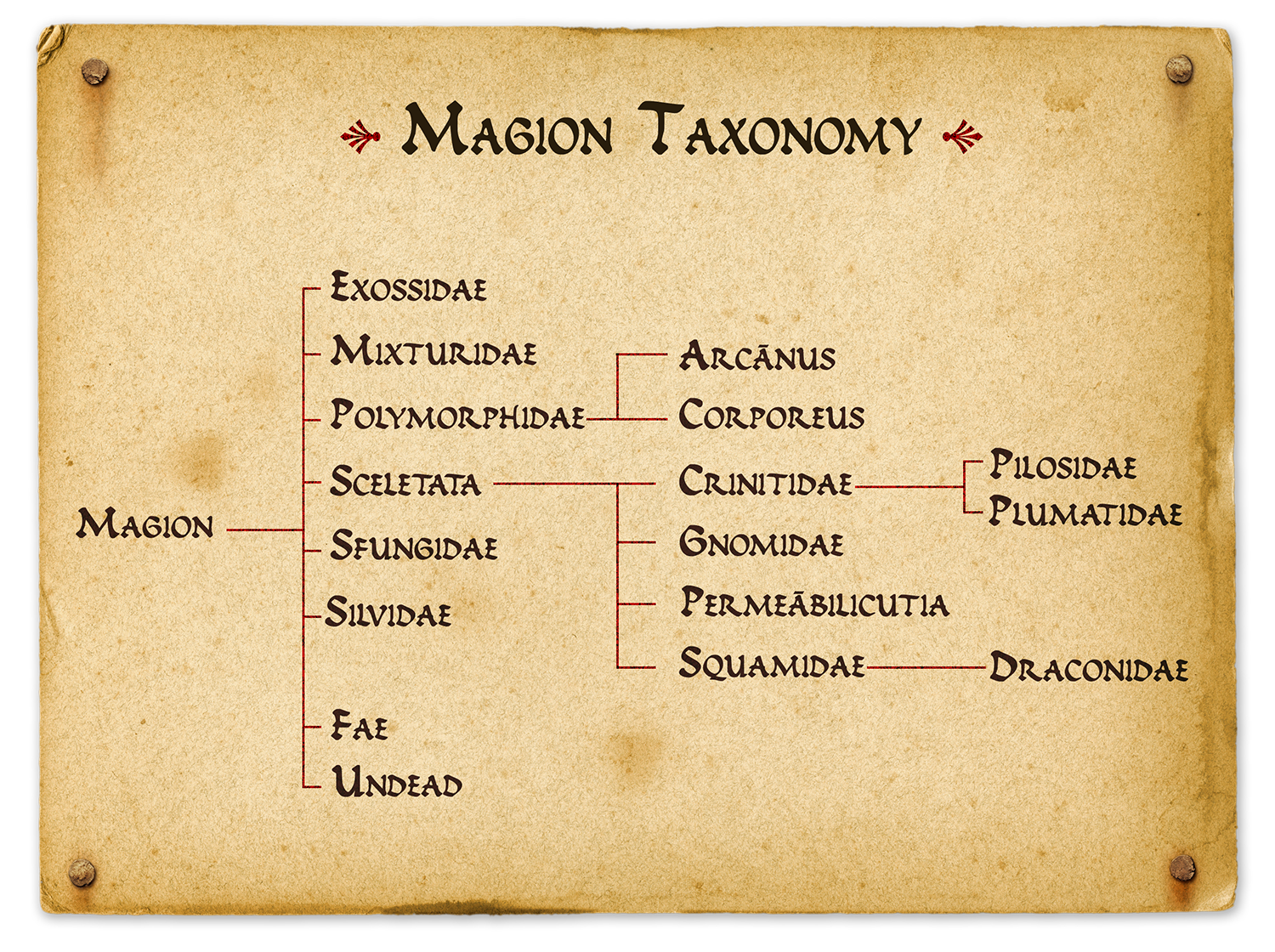
Contemporary scientific taxonomy is much based in genetic research. This is not the case with magion taxonomy,¹ which is more akin to earlier approaches that are based on physical traits. A key difference in magion taxonomy is that in some cases cultural aspects are taken into account in the classification. Non-magical science is human-centric simply because humans are not able to fully communicate with other species. Since many magions are capable of speech, magical studies are not solely based on the perspective of one species, and it is customary to take into account a species self-perception when considering their taxonomic classification.²
Cataloguing System
The cataloguing system in magion taxonomy uses Theban alphabet³ to mark the eight main groups of magions (see table). Either the first or second letter of the group's name is used to mark it. A second small letter is added to mark sub-groups.
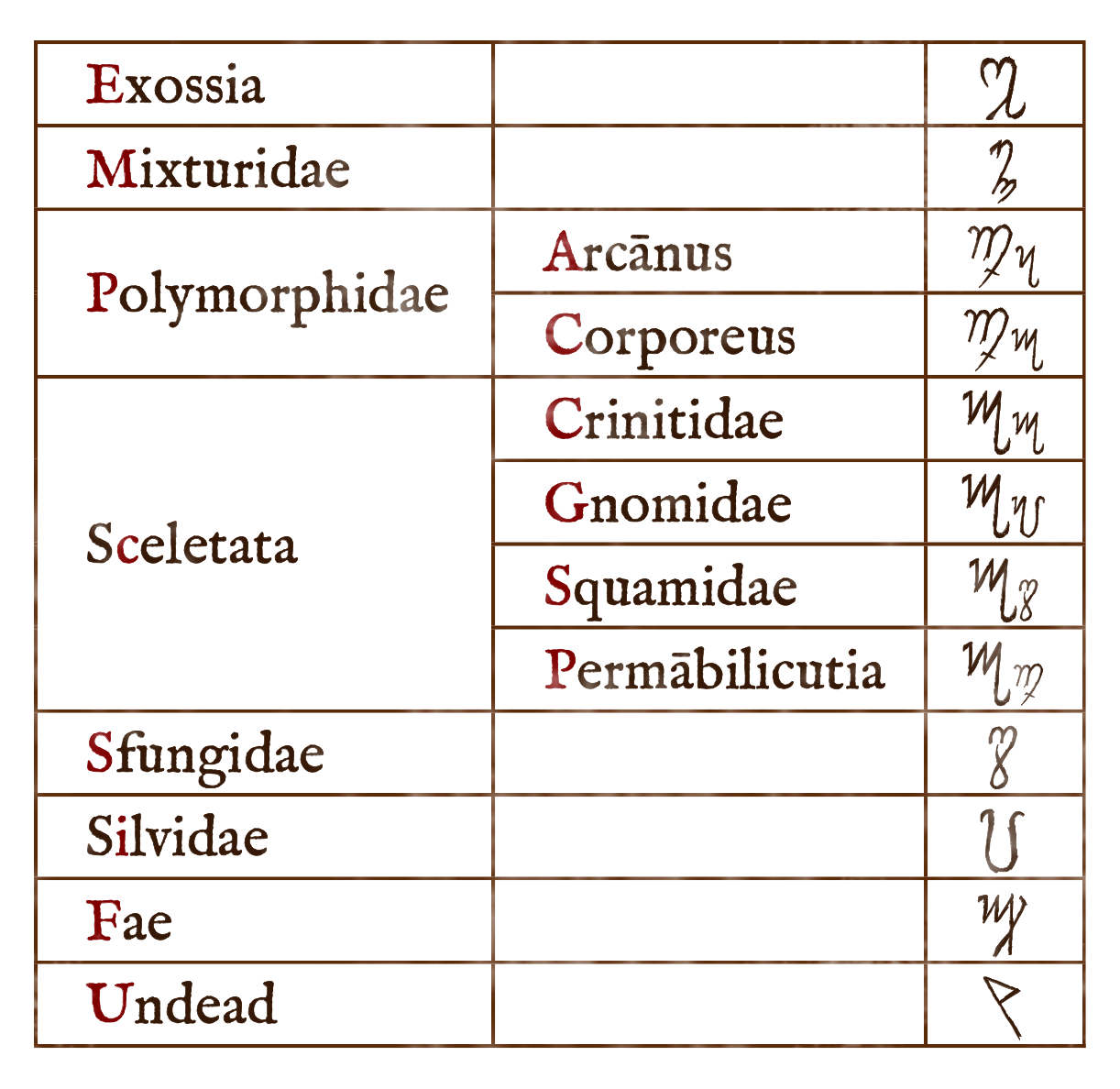
* The cataloguing system is part of magiontology research, and as such can, and does, update from time to time.
Notes
¹ In part, not using genetic research is a question of resources, since magical life are kept secret, but also because the few attempts made made proved that the available processes do not give result with magion samples. It is possible that with much resources something similar to the genome project could be achieved for magions, but at the moment that seems unnecessary. In many ways, what DNA is to non-magical life, magic is to magical life. It is the essence that makes a creature magical. The tools of modern science are not meant for magic, and therefore rarely able to even register it.
² For example, the Polymorphidae group includes a number of shapeshifters that have a human form, called homoformi. However, homoformi are not considered a taxonomic group, because the main division of the Polymorphidae group is based on their shifting style and there are homoformi in both the Arcānus (Arcane shifters) and and Corporeus (Physical shifters) sub-groups. Furthermore, homoformi themselves see their style of changing as more meaningful to their identity than having a human form.
³ The Theban alphabet is an alternative script to the Latin alphabet first published in the 16th century . Its creation is attributed to a medieval scholar named Honorius of Thebes, however it is unclear if such person existed. The Theban alphabet was used by early modern occultists and became popular with the Wicca movement, earning it the nickname the witches’ alphabet. (For more info see Theban alphabet on Wikipedia).


