



Būfo revivens
(Reviving toad)
Other names: miracle toad, devil-star toad, tailed toad, toad of rebirth, devil toad

Introduction video about the Būfo revivens
Basic Information:
Size: 12-17cm
Mass: 20-60g
Lifespan: 10-15 years.
Taxonomy:
Magion - Sceletata - Permeābilicutia - Būfo - revivens
Description:
Descriptions and illustrations of the Būfo revivens suggest that it was very similar in size and appearance to the Common toad (Būfo būfo), with a few distinct differences. Their textured grey skin was very similar to Common toads, but their eyes were dark red in color, instead of the common coppery shade. However, the most distinctive physical trait of the Būfo revivens was their short stubby tail, which made them look a bit like a toadlet.
A second distinct difference was that the Būfo revivens had only one paratoid gland, in contrast to the usual two in toads. Like in other toads, the gland secrete poison that seems to have been a type of bufotoxin.
Mature Būfo revivens.
Descriptions of the poison's effects include many similar to what we know of bufotoxins, such as weakness, hallucination, as well as cardiac arrhythmias or seizures that could lead to coma or death when digested. However, it seems that the Būfo revivens poison had a somewhat different structure, because alongside these effects it is often described as causing the muscles of the body to seize up, effectively paralyzing the victim. In the rare few cases where the paralysis was reversed, the victims related that their mind was active and they could perceive most of what was happening around them, but could not move their muscles.
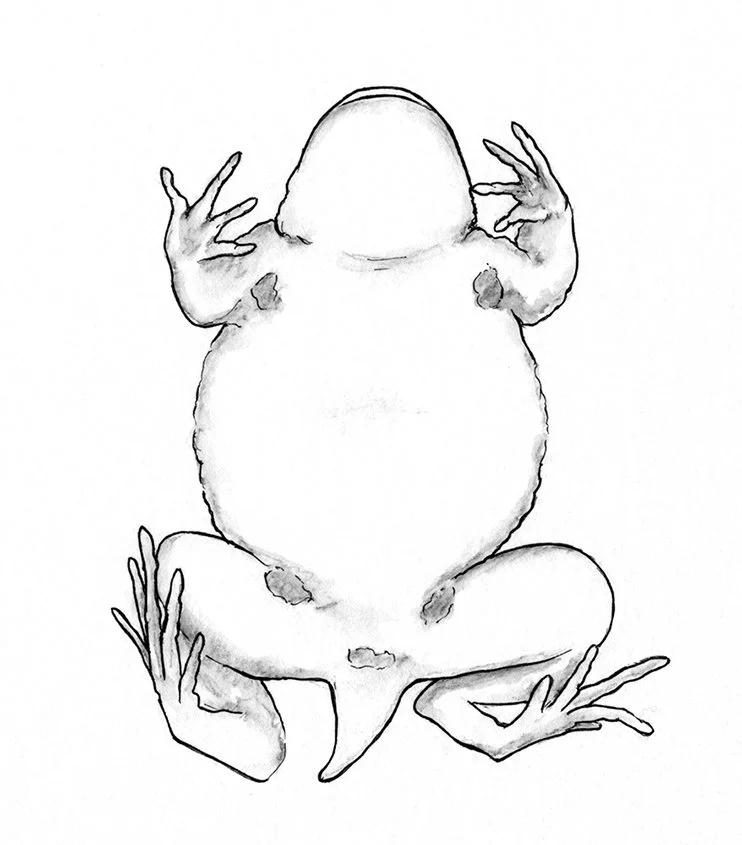
Būfo revivens underside.
The underbelly of the Būfo revivens was a lighter shade of grey, with five darker spots located in the connection points of the limbs, legs and tail, to the body. Many believed that these were magic points, since the Būfo revivens had the ability to shed its limbs in order to escape predators, and to regenerate the lost limb almost instantaneously. Many witnesses described how the limb would detach from the body with no blood, and a strange glow would emanate from the wound as a new limb appeared, growing from the stump within a few moments (see one such description bellow). Some witnesses do not mention a glow, and it is possible that this was a popular addition, as 'mysterious light' is often associated with magical effects.
A 15th century journal in the Magiontology Society Archives collection includes this entry describing a Būfo revivens discard its limb:
“Monday last I observed a most extraordinary phenomenon. A toad captured in a trap immediately relinquished the leg held and as it crawled away a light began to glow from the place the limb was severed and a new leg began to grow. Before my very eyes in only a few moments the three legged toad became four legged and continued to walk away."
The text continues to describe the writer's assumption that they encountered a miracle-toad, and how, after relating the events to others in the village, much discussion arose as to whether it should be captured or killed. But eventually nothing came of it as the toad was not seen again.
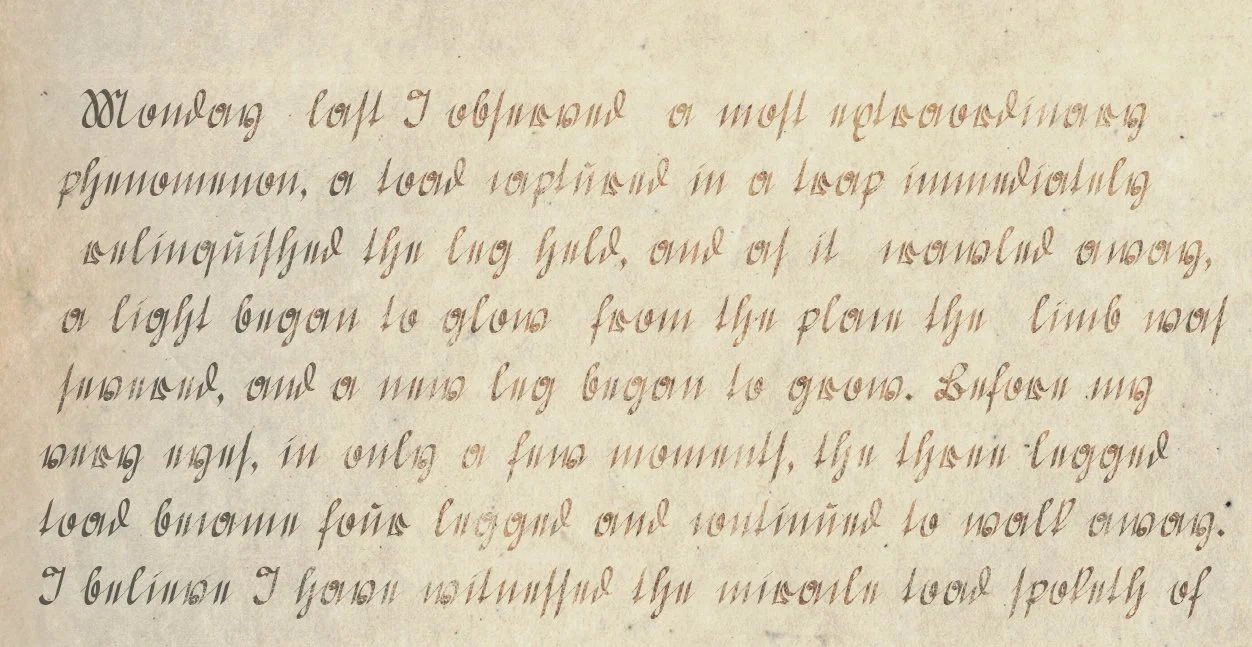
Snippet from the original text.
Habitat:
The Būfo revivens was known across Europe, Eurasia and, in smaller numbers, in North Africa. Records suggest that it prefered wet areas, such as moors and swamps, and forests.
Diet:
Woodlice, slugs, beetles, caterpillars, flies, earthworms and other invertebrates.
Habits & Culture:
The Būfo revivens had an unfortunate combination of traits that attracted ill intentions from a variety of sources. Toads are traditionally associated with witchcraft and the devil in Western culture. The Būfo revivens magical limb regeneration already attracted attention, but the five markings on its belly were also fixated upon because they can be connected in a five-point-star shape. A characteristic which was sometimes accentuated in images (see image on the right, taken from a 12th century manuscript in the Magiontology Society Archives collection).
Its hunters did not always see the Būfo revivens as a separate species from the Common toad, and for centuries it was thought of as a toad marked by its owner witch or by the devil. Witch-hunters and religious zealots listed the Būfo revivens' characteristics as marks of evil, particularly the five spots on its belly.
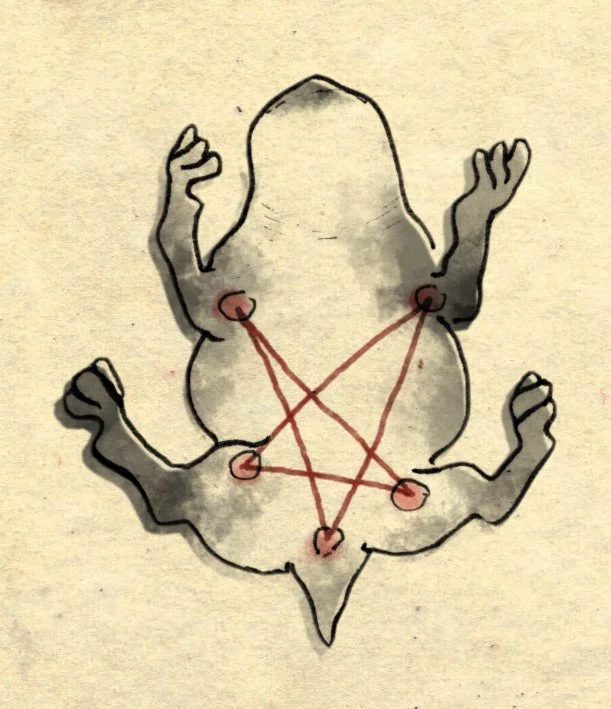
Image from a 12th century manuscript in the Magiontology Archives, showing how the markings on the Būfo revivens underside were connected to a five-point-star shape, thus associating it with the Devil.
It is unclear if the star shape was part of the original art or added by one of the tome's owners. There are two copies of this manuscript in the collection, and one does not include the five-point-star lines. However, being both hand written and drawn, there are several discrepancies between the copies.
The single paratoid gland, located at the back of the Būfo revivens head, was often thought to be a toadstone: a mythical stone, believed to be found in the head of old toads and to have the ability to negate poison and warn of its presence. It was believed that a toad would release the stone voluntarily if placed on a piece of red fabric, which supposadly made it happy, as described by Edward Topsell (c.1572–1625) in his 1608 Historie of Serpents:
“…But the Art (as they terme it) is in taking of it out, for they say it must be taken out of the head alive, before the Toad be dead, with a peece of cloth of the colour of red Skarlet, where-withall they are much delighted, so that they stretch out themselves as it were in sport upon that cloth, they cast out the stone of their head, but instantly they sup it up againe, unlesse it be taken from them through some secrete hole in the said cloth, whereby it falleth into a cestern or vessell of water, into which the Toade dareth not enter, by reason of the coldnes of the water." (See more here)
Unsurprisingly, the red fabric method was not as successful as people hoped. Thomas Nicols (1620-?) brings an example in his 1652 book Lapidary:
“Witnesse Anselmus Boetius ... who saith that to try this experiment in his youth he took an old Toad and laid it upon a red cloth and watch it a whole night to see it belch up its stone, but after his long and tedious watchfull expectation he found the old Toad in the same posture to gratifie the great pains of his whole nights restlessenesse..." (See more here).
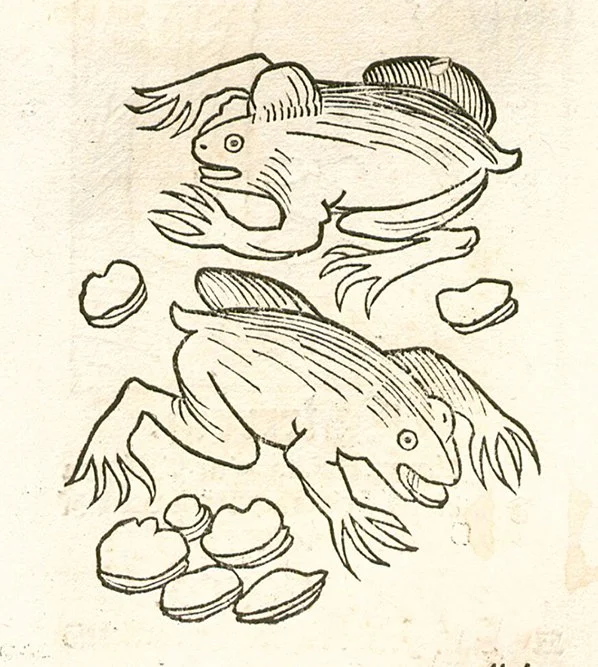
A woodcut illustration taken from the natural history encyclopedia Hortus Sanitatis (Latin for The Garden of Health), which was published by Jacob Meydenbach in Mainz, Germany in 1491. This image appears in page 785 under a discussion of stones.
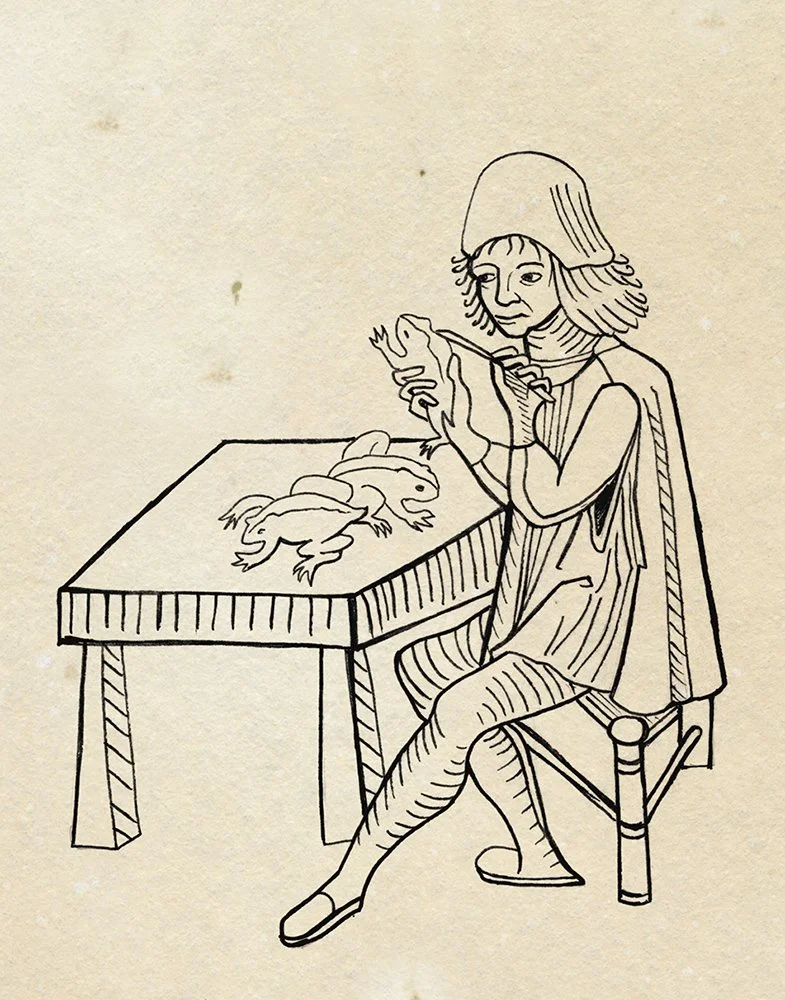
Of course, it did not stop people from attempting to harvest the so-called toadstones, usually while the toad was still alive. Toadstones were not associated with the Būfo revivens specifically, but their single paratoid gland made them particularly attractive to those searching for it. It is now known that toadstones are actually fossilized teeth of an extinct ray-fish genus, however, from the 14th to the 18th centuries, when it was a popular setting stone in rings and amulets, many a toad lost their lives.
15th century grimoire depicting harvesting toadstons (image detail).
However, it was not only human hunters who sought the Būfo revivens. Its regenerating abilities caught the eye of spellcasters and potion makers from as early as the 1st century. Grimoires held in the Magiontology Archives are littered with attempts to use the Būfo revivens poison, discarded members or blood to create healing potions or spells, from simple antiseptics to limb-regrowth and necromancy.
The regenerative magic of the Būfo revivens also made it particularly attractive to practitioners of Parasitical Magic, many of whom believed that the regeneration meant more magic to draw on. The Wīs specifically are known to have held Būfo revivens for both limb gathering and parasitical magic. Their grimoirs included many discussions of possible uses of the Būfo revivens, notes on testing of various harvesting methods and suggestions of how to best use the different parts.
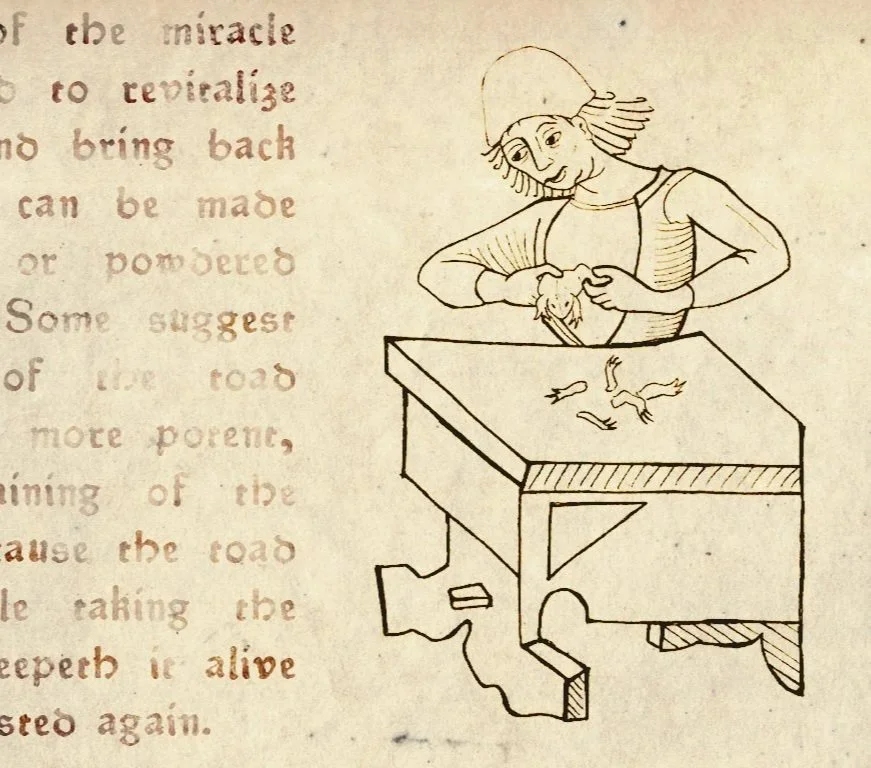
Woodcut illustration, taken from a 15th century grimoire, shows the harvesting of Būfo revivens limbs for use in potions and spells. The accompanying text reads:
"The limbs of the miracle toad are said to revitalize the body, and bring back youth, they can be made into potion or powdered after dried. Some suggest the blood of the toad holdeth even more potent, but the draining of the blood does cause the toad to die, while taking the limbs only keepeth it alive and be harvested again."
The Būfo revivens sadly died out in the 17th century, with the last sighting of the kind recorded in 1614. There have been many searches since, following leads of potions and poison ingredients, but all evidence suggest that these were remnants of old storage, and with no sign of life found, the Būfo revivens were declared extinct.