





Fragrans lētum

Fragrant death

(Spreading death, perfume killer)

X
4-5cm

Carnivorous; prefer large mammals.

Humid and dark environments.

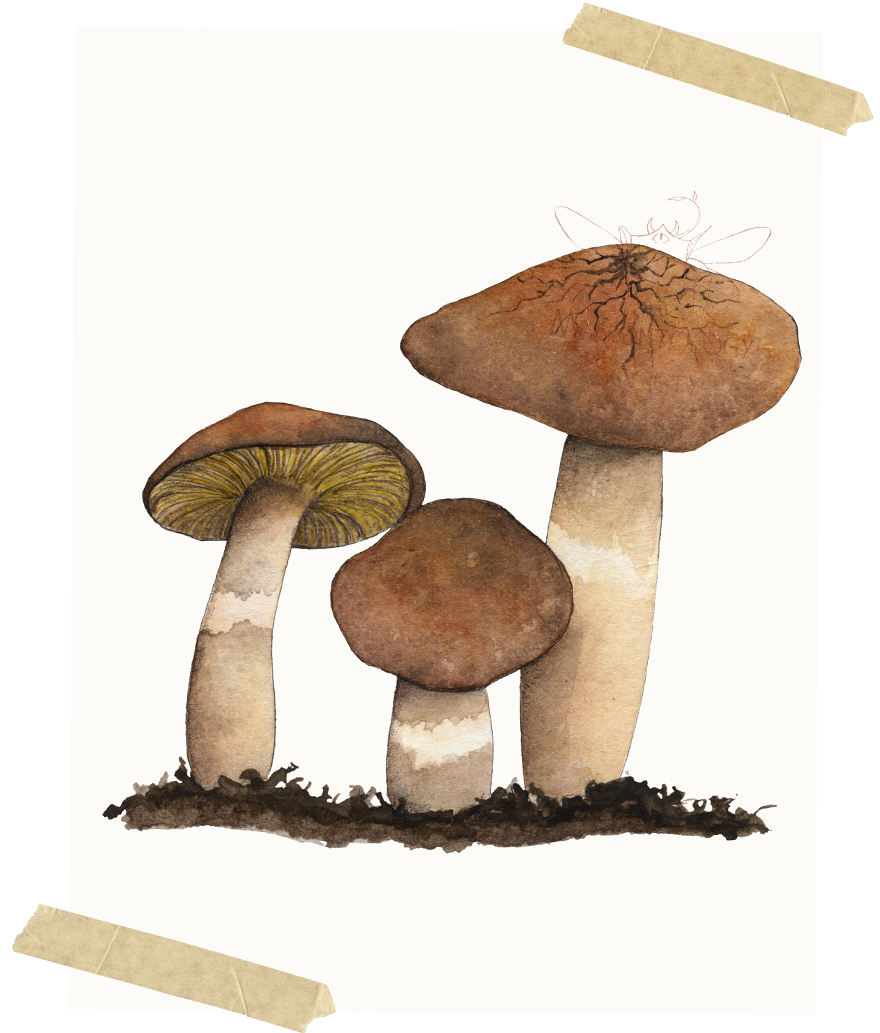
Has similar outside appearance to edible mushrooms, but with a pale, near white, non-flaring median ring (annulus) and dark yellow gills.
Emits a strong and attractive scent. The scent matches what would allure the potential victim. If different members of the group describe different scents – beware.

HIGHLY DANGEROUS. DO NOT EAT OR ALLOW NEAR MOUTH..
Cover your mouth when approaching; wash hands thoroughly after engagement and make sure never to allow any mushroom remnants near your mouth.



Fragrans lētum are decay-inducing mushrooms that prey on mammals. Their appearance is similar to that of edible mushrooms, and they emit an alluring delectable scent to attract their query. The scent is not specific, it changes to match the desires of potential victims, even if several are at hand. if a group of people approaches, one could describe smelling their favourite soup, another pancakes and a third fresh bread or tuna sandwich. The perfume probably has hallucinatory effect as well, since people reported eating the mushrooms in excess without even considering cooking them (although cooking does not prevent infection).
Fragrans lētum can get nutrients from the ground, but for reproduction they require the acidic environment of a stomach. Once ingested, they develop rootlike structures (haustoria) that grow into the body and begin to multiply. Often, by the time pain is observed it is too late. Depending on the size of the victim, they will die within a few hours or a few days once pain begins. The Fragrans lētum will continue to develop and absorb nutrients from the body after death until nothing remains. An average human will die within 2-3 weeks from ingesting the Fragrans lētum. They will fully decompose within 4-5 weeks.
The only known method to stop an infection is a surgical procedure in which Ūnoculīmāx viridis is introduced into the victim’s stomach. While complicated, the procedure has high success ratio (76%) if the infection is identified in early stages.