



Bicaudatus illuminans
(Two-tailed illuminator)
Other names: light speaker, glow cat, rainbow cat
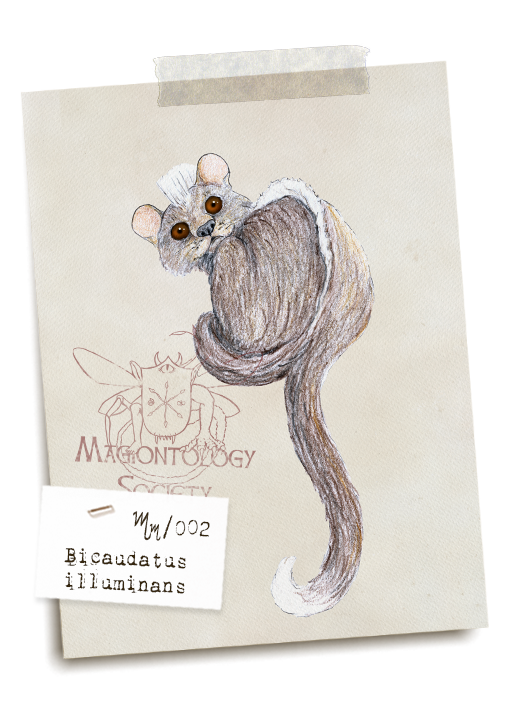
Introduction video about the Bicaudatus illuminans
Basic Information:
Size: Adults reach approx. 60 cm in total, about half of which is the length of the tails.
Mass: 500-600gr
Lifespan: 10 -13 years (can double in captivity)
Taxonomy:
Magion - Crinitidae - Pilosidae - Bicaudatus - illuminans
Description:
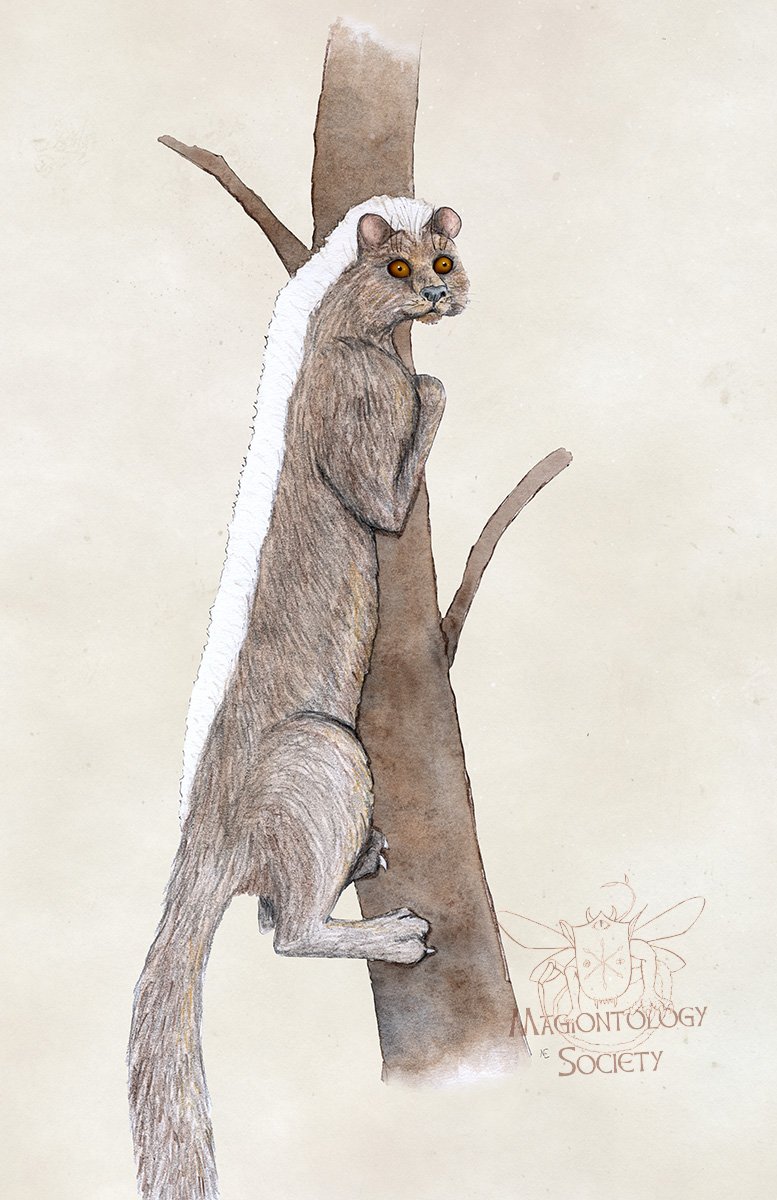
Bicaudatus illuminans are small crinitidae magions of the pilosidae subgroup. Their general appearance has been described as similar to cats and/or ferrets. They have elongated bodies with long legs and relatively large paws. The head is round with round ears and the short snout ends with a black nose and whiskers. The body is covered with mid-length fur, usually light grey-brown in coloring, over a darker and thicker undercoat. There is a strip of longer and lighter, nearly white fur along the back, starting at the top of the head, between the ears, and reaching the base of the tails.
As their name implies, one of the most distinct physical characteristic of the Bicaudatus illuminans is their two tails. The tails are aligned side by side, originating from the same spot at the base of the spine.1 The tails are very long, matching and sometimes passing the length of the body. However, Bicaudatus illuminans tend to curl their tails together tightly, giving the impression of a single thick, and slightly shorter, tail. The main use of the tails is as counterbalance in running and climbing and, depending on the particular movement, will be tightly coiled together or spread wide. Bicaudatus illuminans have been observed to twist or separate their tails en route, changing their positions in matter of seconds.
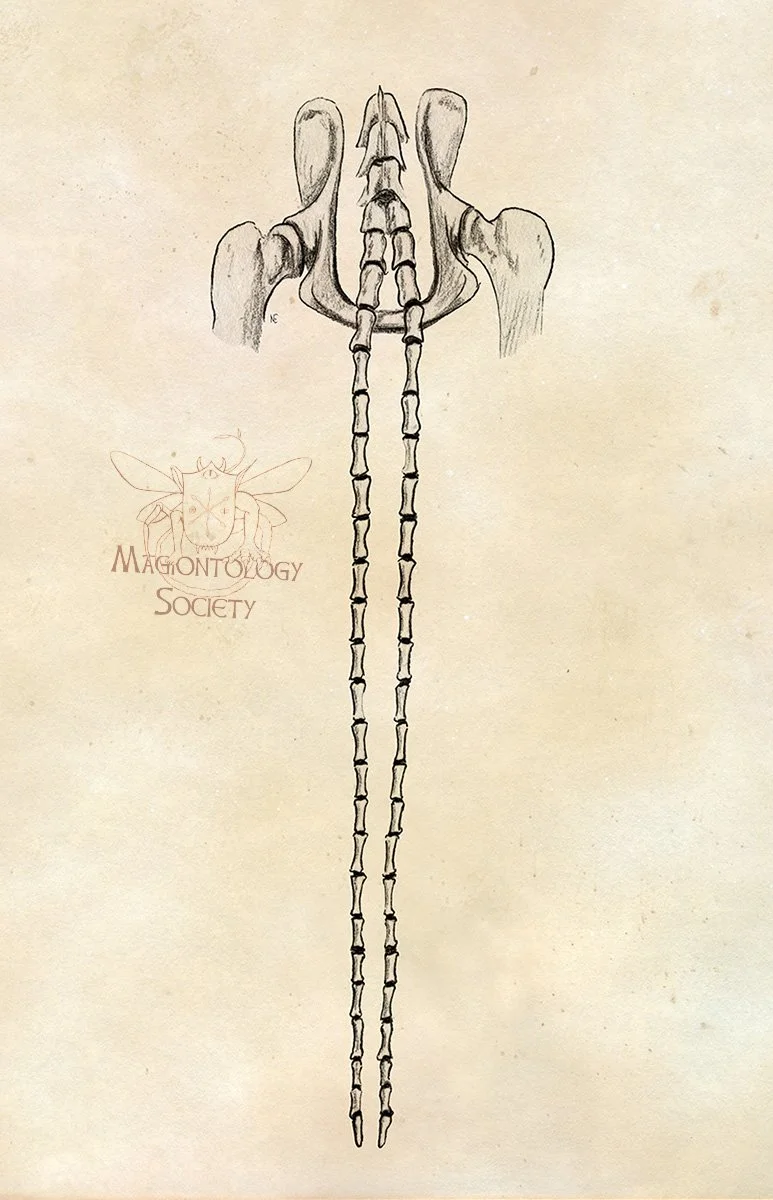
Tail bones of the Bicaudatus illuminans
Bicaudatus illuminans are probably most famous for their bioluminescent communication. They are able of emitting light in different intensity, color and pulse rhythms. Their light-producing cells are concentrated on the top of the back, along the spine, where the light colored hairs aid in the diffusion and spread of the light. Female Bicaudatus illuminans have bioluminescent cells at the tips of their tails as well, as well as matching light-colored hair tufts. These two additional light points are mainly used for communication and play with their cubs.
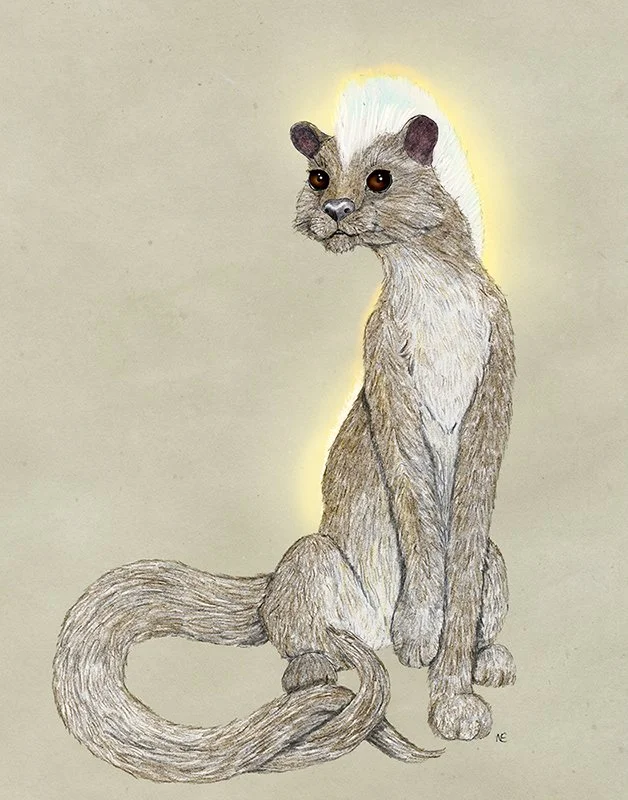
Bicaudatus illuminans signifying calm with his glow.
The bioluminescent communication of Bicaudatus illuminans is very minute and complex, and, while they are capable of producing sounds, they rely more on light. They use combinations of color, intensity and pulse rhythms to convey information from warnings to affection. Scholars who studied Bicaudatus illuminans light-speech found that, for example, emanation of soft golden-yellow light denotes calmness; a quick succession of blue pulses signals danger and is usually followed by complete cut off the light; and that a slow shift between colors in low intensity expresses contentment and calm. The latter is often compared to cat's purring and has been nicknamed "rainbow purring." It has been observed that groups of Bicaudatus illuminans can develop their own variations of light-speech. For example, some groups add a slow pulse to their rainbow purr, while others use continuous light, shifting only the colors.
Habitat:
Bicaudatus illuminans originate in Sub-Saharan Africa, but have also been sighted in North Africa and the Mediterranean. They favor thick woodland and rainforest areas, where their light-communication is less likely to attract the attention of predators.
Deforestation and hunting brought the Bicaudatus illuminans population to near extinction, and today they are very rare. Fortunately, they have shown ability to adapt to different climates and responded well to cultivation efforts. In the present, more than fifty percent of Bicaudatus illuminans live with guardians: magions or magic-folk that are charged with their safety and closely monitor them. Bicaudatus iluminans in their natural habitat are also closely observed, so that they may be relocated if they are deemed to be in danger.
Diet:
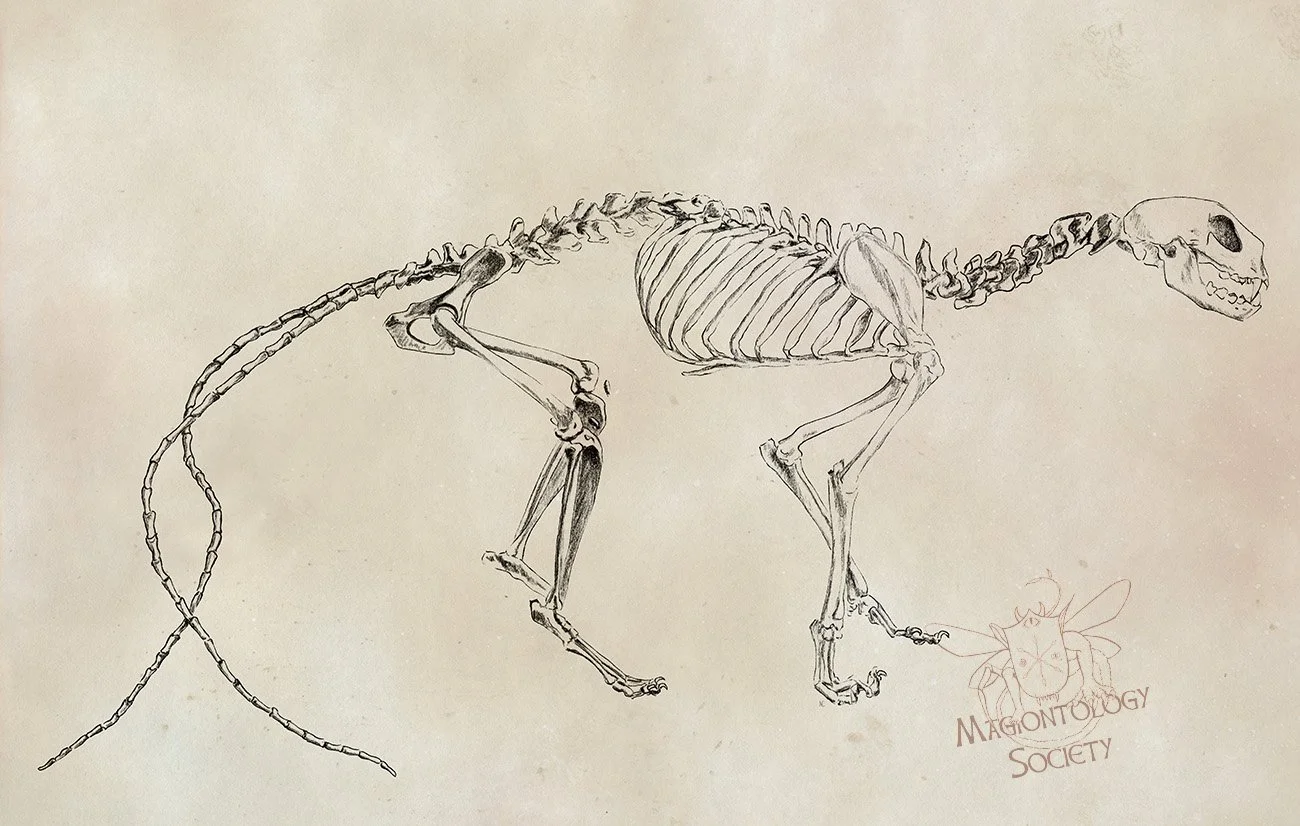
Bicaudatus illuminans skeleton
Bicaudatus illuminans are chiefly carnivorous. They hunt small animals, including small birds and mammals, reptiles and insects, but also eat plants and are particularly fond of fruits. Depending on the area they live in, their diet can be between 20-30% plant based.
Habits & Culture:
Bicaudatus illuminans are social animals and usually form groups of 5-10 individuals, usually of familial relations. They display fission-fusion behavior, with members splitting into subgroups for various activities, and use their light communication to keep in contact. Hunting, for example, is usually done in subgroups of twos or threes, who share their meals, while sleep and rest is commonly done with all members of the parent-group. Members of different groups can interact, and there are recorded cases of two smaller groups joining into one.
Bicaudatus illuminans are mostly nocturnal, hunting at night, and gathering in the parent group for rest during the day. Despite their ability to emit light, they have very good low-light vision, which further cements the notion that their bioluminescence is meant predominantly for communication.2 Light is used both for signaling from afar and for conversing together. When all members of a parent group gather for a rest period, it is common to see different light displayed from subgroups members, presumingly sharing their experiences, which eventually morphs into a communal light display that is joined by all members. Commonly observed collective light displays include shifting into golden-yellow light before slowly dimming the light, or a communal rainbow-purr that fades as they fall asleep.

Bicaudatus illuminans sleeping in a pile.
The bioluminescence of Bicaudatus illuminans had unfortunately made them targets for hunting. Their glow can attract predators, which is why they generally prefer to live in dense forestry, where they can hide in the thicket, and can use their agility and speed to escape into the canopies. However, they often fell prey to human hunters that sought them for their "glowing fur". Of course, since their light is the result of biological processes, the specimen must be alive to produce it, but unfortunately that did not stop hunters from trying. In the 16th century the Bicaudatus illuminans population suffered a drastic decline, and survived only in dense wooded land where humans rarely reached. Deforestation in the modern age had brought them to the brink of extinction.
Fortunately, they persevered and in recent years their numbers have stabilized and even rose, thanks to preservation efforts beginning they early 1980s. Under the 1983 Magion Protection Accords, Bicaudatus illuminans were named one of the magion species to be closely monitored, and a few groups that were designated highly endangered were relocated and placed under the care of designated guardians. This was a success, and while the number of Bicaudatus illuminans groups in the world is still low, they are currently not considered endangered.
Notes:
[1] For a while there was a lively debate among magiontologists on whether these should be considered two seperate tails or one tail that is split in two. During a particularly excitable debate in January 1890 ,Laurie Eagelon (1837-1928), one of the founding members of the Magiontology Circle (1889-1892), commented that "This whole debate is really about which bone is defined as the first tail bone, you may as well argue on whether it is a tail at all or simply a few extra vertebrae." Which rather dampened the debate.
[2] There is evidence that some Bicaudatus illuminans groups learned to attract insects with their bioluminescence and then capture them. This is a learned behavior that was passed from one group to another, showcasing that Bicaudatus illuminans from different groups communicate amiably. However, while this technique does attact insects, it still requires high agility and practice to capture the prey and can posit the hunter in danger of exposure to predators. Therefore, not all groups that began exhibiting this technique embraced it.